
Pearl millet (Pennisetum glaucum (L.) R. Br) is a very important cereal crop in the semi-arid regions of West Africa, serving as a primary food source for local populations. Therefore, its productivity remains lowered by soil degradation and low availability of inputs as fertilizers. In this context, biofertilizers and organic amendments offer sustainable and ecological alternatives for enhancing crop performance. This study aims to contribute to improve pearl millet production through the application of biofertilizers arbuscular mycorrhizal fungi (AMF) and plant growth-promoting rhizobacteria (PGPR) combined with microdose NPK. The research focuses on two soils of the peanut basin of Senegal (Touba Toul and Gossas). Thus, a greenhouse experiment was conducted using a completely randomized block design with five treatments (control, microdose, fungal inoculation (AMF), bacterial inoculation (PGPR) and dual inoculation (AMF+PGPR)) and five replicates, on each of the two soils. The parameters assessed included mycorrhization, collar diameter, number of leaves, chlorophyll content, shoot and root biomass, and ears length. Results revealed that, the microdose generated the best agronomic performance, including 46% increase in chlorophyll content and 30% increase in collar diameter compared to control. The AMF, PGPR and AMF+PGPR treatments showed more variable effects. While close to some parameters such as shoot biomass, improved significantly (up to 20% increase), but with no significant improvement in root biomass (1.02% increase). A notable site effect was observed: Touba Toul proved to be more favourable for millet growth, with an overall performance increase of around 60% compared to Gossas. These findings suggest that combining biofertilization with fertilizer microdosing could be a promising strategy for sustainable pearl millet production in sahelian regions.
| Published in | International Journal of Applied Agricultural Sciences (Volume 12, Issue 4) |
| DOI | 10.11648/j.ijaas.20261204.11 |
| Page(s) | 110-119 |
| Creative Commons |
This is an Open Access article, distributed under the terms of the Creative Commons Attribution 4.0 International License (http://creativecommons.org/licenses/by/4.0/), which permits unrestricted use, distribution and reproduction in any medium or format, provided the original work is properly cited. |
| Copyright |
Copyright © The Author(s), 2026. Published by Science Publishing Group |
Pearl Millet (Pennisetum glaucum), Arbuscular Mycorrhizal Fungi (AMF), Plant Growth Promoting Rhizobacteria (PGPR), Fertilizer Microdose, Inoculation
Treatments | Description |
|---|---|
T0 | Control (without any fertilization, or inoculation) |
T1 | Microdose = Compost (400g) + Urea (2g) + NPK (3g) |
T2 | AMF (Rhizoglomus irregularis + Rhizoglomus aggregatum) (20g) |
T3 | PGPR (LCM5016 + LCM 4370) (5mL) |
T4 | AMF (Rhizoglomus irregularis + Rhizoglomus aggregatum) (20g) + PGPR (LCM5016 + LCM 4370) (5mL) |
Component elements (content per 100g of soil) | Touba Toul | Gossas |
|---|---|---|
Clay | 3.6% | 3.4% |
Silt | 1.6% | 1.7% |
Fine silt | 2.9% | Nd |
Fine sand | 51% | 4.3% |
Medium sand | Nd | 69.9% |
Coarse sand | 40.9% | 20.8% |
Conductivity | 65 µs/cm | 2 µs/cm |
C | 1.57% | 2.23% |
Organic matter | 1.24% | 1.41% |
N | 0.11% | 0.21% |
C / N | 11% | 11.6% |
Total P | 47 ppm | 39 ppm |
Assimilable phosphorus | 3.1 ppm | 2.1 ppm |
pH (soil/water ratio 1: 2) | 6.8 | 5.6 |
Treatment | Plant height (cm) | Chlorophyll content (SPAD) | Neck diameter (mm) | Number of leaves | Shoot biomass (g) | Root biomass (g) |
|---|---|---|---|---|---|---|
T0 | 87.4 ± 16.56 a | 18.89 ± 0.43 a | 5.9 ± 3.38 ab | 8.2 ± 3.27 a | 1.44 ± 0.88 a | 1.04 ± 0.7 ab |
T1 | 125.2 ± 33.38 a | 38.65 ±5.02 b | 16.65 ±5.02 b | 27.0 ± 16.01 b | 15.48 ± 1.32 b | 4.34 ± 1.3 b |
T2 | 92.8 ± 17.9 a | 35.43 ± 0.38 b | 3.57 ± 1.93 a | 9.2 ± 1.3 ab | 1.62 ± 1.00 a | 1.36 ± 0.76 ab |
T3 | 94.2 ± 13.36 a | 32.31 ± 3.8 b | 4.00 ± 0.43 ab | 8.8 ± 0.83 ab | 1.8 ± 0.94 ab | 0.8 ± 0.15 a |
T4 | 93.8 ± 15.27 a | 19.06±3.59 ab | 3.96 ± 1.27 a | 7.6 ± 2.3 a | 1.92 ± 0.67 ab | 0.68 ± 0.11 a |
Average ± SD | 98.88±23.26 | 28.86±9.5 | 6.82±5.73 | 12.16±10.17 | 4.46±5.95 | 1.64±1.55 |
RESUME (%) | 24 | 32.9 | 84 | 84 | 133 | 95 |
p-value | 0.201 | 0.016* | 0.016* | 0.016* | 0.005** | 0.005* |
Treatment | Plant height (cm) | Chlorophyll content (SPAD value) | Neck diameter (mm) | Number of leaves | Shoot biomass (g) | Root biomass (g) |
|---|---|---|---|---|---|---|
T0 | 124.2 ± 20.60 ab | 14.56 ± 7.57 ab | 6.63 ± 1.33 a | 8.4 ± 2.07 ab | 7.18 ± 1.53 a | 1.98 ± 0.88 ab |
T1 | 139.2 ± 14.11 b | 37.42 ± 3.31 b | 15.42 ±5.07 b | 15.4 ± 7.09 b | 23.22 ± 6.63 b | 4.04 ± 1.32 b |
T2 | 138.4 ± 13.22 b | 8.4 ± 3.0 ab | 6.12 ± 0.96 a | 8.0 ± 3.0 ab | 9.88 ± 2.06 ab | 1.94 ± 1.00 ab |
T3 | 128.6 ± 8.64 ab | 4.74 ± 0.9 a | 6.02 ± 0.53 a | 6.8 ± 0.83 a | 9.14 ± 0.9 ab | 1.54 ± 0.94 ab |
T4 | 112.4 ± 6.64 a | 4.96 ± 1.86 a | 7.89 ± 1.84 ab | 6.8 ± 1.3 a | 8.64 ± 0.94 a | 1.38 ± 0.67 a |
Average ± SD | 128.56±15.97 | 14.01±13.01 | 7.93±4.48 | 9.08±4.67 | 11.61±6.68 | 2.17±1.33 |
RESUME (%) | 12.42 | 93 | 56 | 51 | 58 | 61 |
p-value | 0.043* | 0.001** | 0.023* | 0.019* | 0.002** | 0.04* |
AMF | Arbuscular Mycorrhizal Fungi |
PGPR | Plant Growth-promoting Rhizobacteria |
NPK | Mineral Fertilizer, Nitrogen Phosphorus Potassium |
LBC | Laboratory of Fungal Biotechnology (LBC) |
LCM | Laboratory of Microbiology IRD/ISRA/UCAD |
ANOVA | Analysis of Variance |
| [1] | Bationo, A., Kihara, J., Vanlauwe, B., Waswa, B., Kimetu, J. Soil organic carbon dynamics, functions and management in West African agro-ecosystems. Agricultural Systems. 2007, 94(1), 13‑25. |
| [2] | Debieu, M., Sine, B., Passot, S., Grondin, A., Akata, E., Gangashetty, P., Vadez, V., Gantet, P., Foncéka, D., Cournac, L., Hash, C. T., Kane, N. A., Vigouroux, Y., Laplaze, L. Response to early drought stress and identification of QTLs controlling biomass production under drought in pearl millet. PLOS ONE. 2018, 13(10), e0201635. |
| [3] | Diacono, M., Montemurro, F. Long-Term Effects of Organic Amendments on Soil Fertility. In E. Lichtfouse, M. Hamelin, M. Navarrete, & P. Debaeke (Éds.), Sustainable Agriculture Springer Netherlands. 2011, 1, 761‑786. |
| [4] | Dickie, I. A., Alexander, I., Lennon, S., Öpik, M., Selosse, M.-A., van Der Heijden, M. G., Martin, F. M. Evolving insights to understanding mycorrhizas. New Phytologist. 2015, 205(4), 1369‑1374. |
| [5] | Faye, A., Stewart, Z. P., Diome, K., Edward, C.-T., Fall, D., Ganyo, D. K. K., Akplo, T. M., Prasad, P. V. V. Single Application of Biochar Increases Fertilizer Efficiency, C Sequestration, and pH over the Long-Term in Sandy Soils of Senegal. Sustainability. 2021, 13(21), 11817. |
| [6] | Fisher, R. A., Yates, F. Statistical tables for biological, agricultural and medical research. 1963, 449. |
| [7] | Gamalero, E., Glick, B. R. Bacterial modulation of plant ethylene levels. Plant Physiology. 2015, 169(1), 13–22. |
| [8] | Gandah, M., Bouma, J., Brouwer, J., Hiernaux, P., Van Duivenbooden, N. Strategies to optimize allocation of limited nutrients to sandy soils of the Sahel: A case study from Niger, west Africa. Agriculture, Ecosystems & Environment. 2003, 94(3), 311‑319. |
| [9] | Goswami, L., Nath, A., Sutradhar, S., Bhattacharya, S. S., Kalamdhad, A., Vellingiri, K., Kim, K.-H. Application of drum compost and vermicompost to improve soil health, growth, and yield parameters for tomato and cabbage plants. Journal of Environmental Management. 2017, 200, 243‑252. |
| [10] | Gram, G., Roobroeck, D., Pypers, P., Six, J., Merckx, R., Vanlauwe, B. Combining organic and mineral fertilizers as a climate-smart integrated soil fertility management practice in sub-Saharan Africa: A meta-analysis. PLOS ONE. 2020, 15(9), e0239552. |
| [11] | Gupta, G., Dhar, S., Kumar, A., Choudhary, A. K., Dass, A., Sharma, V. K., Shukla, L., Upadhyay, P. K., Das, A., Jinger, D., Rajpoot, S. K., Sannagoudar, M. S., Kumar, A., Bhupenchandra, I., Tyagi, V., Joshi, E., Kumar, K., Dwivedi, P., Rajawat, M. V. S. Microbes-mediated integrated nutrient management for improved rhizo-modulation, pigeonpea productivity, and soil bio-fertility in a semi-arid agro-ecology. Frontiers in Microbiology. 2022, 13, 924407. |
| [12] | Ibrahim, A. L. I., Abaidoo, R. C., Fatondji, D., Opoku, A. Determinants of fertilizer microdosing-induced yield increment of pearl millet on an acid sandy soil. Experimental Agriculture. 2016, 52(4), 562‑578. |
| [13] | Jiaying, M, Tingting, C., Jie, L., Weimeng, F., Baohua, F., Li, G., Li, H., Li, J., Zhihai, W., Longxing, T., Fu, G. Functions of Nitrogen, Phosphorus and Potassium in Energy Status and Their Influences on Rice Growth and Development. Rice Science. 2021, 29 (2), 166-178. |
| [14] | Joshi, S., Joshi N., Tariq A., Khursheed M., Jan R., Singh, K. C., Sultan A., Kashyap M., Rajgonda K. P., Tutlani A. Integrating Biofertilizers in Nutrient Management of Millets: A Review of Advances and Prospects. Journal of Experimental Agriculture International. 2025, 47(11), 638–653. |
| [15] | Kolapo, A., Oluwatayo, I. B., Ayojimi, W., Eniola, A. T., Sieber, S. Enhancing fertilizer-use-efficiency through fertilizer microdosing as climate-smart practices among crop farmers in North Central, Nigeria. Frontiers in Sustainable Food Systems. 2025, 9, 1497716. |
| [16] | Kugedera, A. T., Trivedi, A., Nandeha, N., Biswas, A. Agroforestry and integrated nutrient management as climate-smart agro-technologies for soil health and climate change mitigation: A review on African and Asian regions. Discover Agriculture. 2025, 3(1), 272. |
| [17] | Kumar S., Diksha, Sindhu S. S., Kumar R. Biofertilizers: An ecofriendly technology for nutrient recycling and environmental sustainability. Current Research in Microbial Science. 2021, 20 (3): 100094. |
| [18] | Lal, R. Soil organic matter content and crop yield. Journal of Soil and Water Conservation. 2020, 75(2), 1. |
| [19] | Ludemann, C. I., Gruere, A., Heffer, P., Dobermann, A. Global data on fertilizer use by crop and by country. Scientific data. 2022, 9(1), 501. |
| [20] | Marschner, H. Marschner’s Mineral Nutrition of Higher Plants. Academic Press, Third Edition. 2012, 369-388. |
| [21] | Merga, D. Pearl Millet (Pennisetum glaucum L.) Breeding for Adaptation and Performance Under Drought Condition: Review. Journal of Environment and Earth Science. 2020, 10(4), 1. |
| [22] | Ndiaye M, Mollier A, Diouf A, Diop TA. Mycorrhizal inoculation and fertilizer microdosing interactions in pearl millet (Pennisetum glaucum) under greenhouse conditions. Frontiers in Fungal Biology. 2024, 5: 1448156. |
| [23] | Nishigaki, T., Ikazaki, K., Shinjo, H., Tanaka, U., Fatondji, D., Funakawa, S. Pearl millet yield reduction by soil erosion and its recovery potential through fertilizer application on an Arenosol in the Sahel. Soil and Tillage Research. 2025, 246, 106324. |
| [24] | Ouedraogo, Y., J.-B. S. Taonda, I. Sermé, B. Tychon, J. T. Cornelis, H. B. Nacro, C. L. Bielders. “Fertiliser Microdosing and Organic Amendments as an Integrated Soil Fertility Management Strategy: Evidence From On-Farm Sorghum Trials in Burkina Faso. Soil Use and Management. 2026, 42(1): e70182. |
| [25] | Ouedraogo, Y., Taonda, J S., Sermé, I., Tychon, B., Bielders, C L. Factors driving cereal response to fertilizer microdosing in sub‐Saharan Africa: A meta‐analysis. Agronomy Journal. 2020, 112(4), 2418‑2431. |
| [26] | Phillips, J. M., Hayman, D. S. Improved procedures for clearing roots and staining parasitic and vesicular-arbuscular mycorrhizal fungi for rapid assessment of infection. Transactions of the British mycological Society. 1970, 55(1), 158-IN18. |
| [27] | Ramírez, P. B., Calderón, F. J., Vigil, M. F., Mankin, K. R., Poss, D., Fonte, S. J. Dryland Winter Wheat Production and Its Relationship to Fine-Scale Soil Carbon Heterogeneity—A Case Study in the US Central High Plains. Agronomy. 2023, 13(10), 2600. |
| [28] | Samba, R. T., Faye, M. S., Diouf, D., Ndiaye C., Tendeng P., Sylla, S. N. Synergic effect of Arbuscular mycorrhizal fungi (AMF) and rhizobia on Vachellia nilotica subsp adansonii (Guill & Perr) Kuntze's symbiotic properties and growth under salinity conditions. International Journal of Biodiversity and Conservation. 2026, 18(1), 67-81. |
| [29] | Sanoussi, S. İ. M., Dougbedji, F., Matthew, E., Okhimamhe, A. a, Ibrahim, A., Sule, İ. Assessing soil nutrient change under long-term application of mineral fertilizer micro-dosing to pearl millet [Pennisetum glaucum (L.) R. Br.] on a sahelian sandy soil. Eurasian Journal of Soil Science. 2020, 9(1), 34‑42. |
| [30] | Savastano, N., Bais, H. Synergism or Antagonism: Do Arbuscular Mycorrhizal Fungi and Plant Growth-Promoting Rhizobacteria Work Together to Benefit Plants? International Journal of Plant Biology. 2024, 15(4), 944‑958. |
| [31] |
Sieverding, E., Friedrichsen, J., Suden, W. Vesicular-arbuscular mycorrhiza management in tropical agrosystems. 1991.
https://agris.fao.org/search/en/providers/122438/records/6477592af2e6fe92b365e1bf |
| [32] | Silungwe, F. R., Graef, F., Dorothea Bellingrath-Kimura, S., Chilagane, E. A., Tumbo, S. D., Kahimba, F. C., Lana, M. A. Modelling rainfed pearl millet yield sensitivity to abiotic stresses in semi-arid central Tanzania, Eastern Africa. Sustainability. 2019, 11(16), 4330. |
| [33] | Tilman, D., Cassman, K. G., Matson, P. A., Naylor, R., Polasky, S. Agricultural sustainability and intensive production practices. Nature. 2002, 418(6898), 671‑677. |
| [34] | Tittonell, P., Giller, K. E. When yield gaps are poverty traps: The paradigm of ecological intensification in African smallholder agriculture. Field Crops Research. 2013, 143, 76‑90. |
| [35] | Trouvelot, A. Measurement of the mycorrhization rate of a root system. Research on estimation methods with functional relevance. Physiological and genetical aspects of mycorrhizae. 1986, 217‑221. |
| [36] | Vafa, Z. N., Sohrabi, Y., Sayyed, R. Z., Luh Suriani, N., Datta, R. Effects of the combinations of rhizobacteria, mycorrhizae, and seaweed, and supplementary irrigation on growth and yield in wheat cultivars. Plants. 2021, 10(4), 811. |
| [37] | Van der Heijden, M. G. A., Martin, F. M., Selosse, M. A., Sanders, I. R. Mycorrhizal ecology and evolution: the past, the present, and the future. New Phytologist. 2015, 205(4), 1406–1423. |
| [38] | Vieira Junior, N., Carcedo, A. J. P., Min, D., Diatta, A. A., Araya, A., Prasad, P. V., Diallo, A., Ciampitti, I. Management interventions of pearl millet systems for attaining cereal self-sufficiency in Senegal. Frontiers in Sustainable Food Systems. 2024, 7, 1281496. |
| [39] | Weil, R. R., Brady, N. C. The nature and properties of soils (Fifteenth edition). Pearson. 2017. |
| [40] | Xing, Y., Xie, Y., & Wang, X. (2025). Enhancing soil health through balanced fertilization: a pathway to sustainable agriculture and food security. Frontiers in microbiology, 16, 1536524. |
| [41] | Yang, K., Zhang, Q., Zhu, J., Wang, Q., Gao, T., Wang, G. G. Mycorrhizal type regulates trade-offs between plant and soil carbon in forests. Nature Climate Change. 2024, 14(1), 91‑97. |
| [42] | Yu, L., Zhang H., Zhang W., Liu K., Liu M., Shao X. Cooperation between arbuscular mycorrhizal fungi and plant growth-promoting bacteria and their effects on plant growth and soil quality. PeerJ. 2022, 10: e13080. |
APA Style
Diaw, K., Samba, R. T., Ndiaye, M., Ndiaye, M. A. F. (2026). Effect of fertilizer Microdosing of and Microbial Inoculation on Pearl Millet (Pennisetum glaucum (L.) R. Br) Growth on Two Soils of the Peanut Basin of Senegal. International Journal of Applied Agricultural Sciences, 12(4), 110-119. https://doi.org/10.11648/j.ijaas.20261204.11
ACS Style
Diaw, K.; Samba, R. T.; Ndiaye, M.; Ndiaye, M. A. F. Effect of fertilizer Microdosing of and Microbial Inoculation on Pearl Millet (Pennisetum glaucum (L.) R. Br) Growth on Two Soils of the Peanut Basin of Senegal. Int. J. Appl. Agric. Sci. 2026, 12(4), 110-119. doi: 10.11648/j.ijaas.20261204.11
AMA Style
Diaw K, Samba RT, Ndiaye M, Ndiaye MAF. Effect of fertilizer Microdosing of and Microbial Inoculation on Pearl Millet (Pennisetum glaucum (L.) R. Br) Growth on Two Soils of the Peanut Basin of Senegal. Int J Appl Agric Sci. 2026;12(4):110-119. doi: 10.11648/j.ijaas.20261204.11
@article{10.11648/j.ijaas.20261204.11,
  author = {Khady Diaw and Ramatoulaye Thiaba Samba and Malick Ndiaye and Mame Arame Fall Ndiaye},
  title = {Effect of fertilizer Microdosing of and Microbial Inoculation on Pearl Millet (Pennisetum glaucum (L.) R. Br) Growth on Two Soils of the Peanut Basin of Senegal},
  journal = {International Journal of Applied Agricultural Sciences},
  volume = {12},
  number = {4},
  pages = {110-119},
  doi = {10.11648/j.ijaas.20261204.11},
  url = {https://doi.org/10.11648/j.ijaas.20261204.11},
  eprint = {https://article.sciencepublishinggroup.com/pdf/10.11648.j.ijaas.20261204.11},
  abstract = {Pearl millet (Pennisetum glaucum (L.) R. Br) is a very important cereal crop in the semi-arid regions of West Africa, serving as a primary food source for local populations. Therefore, its productivity remains lowered by soil degradation and low availability of inputs as fertilizers. In this context, biofertilizers and organic amendments offer sustainable and ecological alternatives for enhancing crop performance. This study aims to contribute to improve pearl millet production through the application of biofertilizers arbuscular mycorrhizal fungi (AMF) and plant growth-promoting rhizobacteria (PGPR) combined with microdose NPK. The research focuses on two soils of the peanut basin of Senegal (Touba Toul and Gossas). Thus, a greenhouse experiment was conducted using a completely randomized block design with five treatments (control, microdose, fungal inoculation (AMF), bacterial inoculation (PGPR) and dual inoculation (AMF+PGPR)) and five replicates, on each of the two soils. The parameters assessed included mycorrhization, collar diameter, number of leaves, chlorophyll content, shoot and root biomass, and ears length. Results revealed that, the microdose generated the best agronomic performance, including 46% increase in chlorophyll content and 30% increase in collar diameter compared to control. The AMF, PGPR and AMF+PGPR treatments showed more variable effects. While close to some parameters such as shoot biomass, improved significantly (up to 20% increase), but with no significant improvement in root biomass (1.02% increase). A notable site effect was observed: Touba Toul proved to be more favourable for millet growth, with an overall performance increase of around 60% compared to Gossas. These findings suggest that combining biofertilization with fertilizer microdosing could be a promising strategy for sustainable pearl millet production in sahelian regions.},
 year = {2026}
}
TY  - JOUR
T1  - Effect of fertilizer Microdosing of and Microbial Inoculation on Pearl Millet (Pennisetum glaucum (L.) R. Br) Growth on Two Soils of the Peanut Basin of Senegal
AU  - Khady Diaw
AU  - Ramatoulaye Thiaba Samba
AU  - Malick Ndiaye
AU  - Mame Arame Fall Ndiaye
Y1  - 2026/07/03
PY  - 2026
N1  - https://doi.org/10.11648/j.ijaas.20261204.11
DO  - 10.11648/j.ijaas.20261204.11
T2  - International Journal of Applied Agricultural Sciences
JF  - International Journal of Applied Agricultural Sciences
JO  - International Journal of Applied Agricultural Sciences
SP  - 110
EP  - 119
PB  - Science Publishing Group
SN  - 2469-7885
UR  - https://doi.org/10.11648/j.ijaas.20261204.11
AB  - Pearl millet (Pennisetum glaucum (L.) R. Br) is a very important cereal crop in the semi-arid regions of West Africa, serving as a primary food source for local populations. Therefore, its productivity remains lowered by soil degradation and low availability of inputs as fertilizers. In this context, biofertilizers and organic amendments offer sustainable and ecological alternatives for enhancing crop performance. This study aims to contribute to improve pearl millet production through the application of biofertilizers arbuscular mycorrhizal fungi (AMF) and plant growth-promoting rhizobacteria (PGPR) combined with microdose NPK. The research focuses on two soils of the peanut basin of Senegal (Touba Toul and Gossas). Thus, a greenhouse experiment was conducted using a completely randomized block design with five treatments (control, microdose, fungal inoculation (AMF), bacterial inoculation (PGPR) and dual inoculation (AMF+PGPR)) and five replicates, on each of the two soils. The parameters assessed included mycorrhization, collar diameter, number of leaves, chlorophyll content, shoot and root biomass, and ears length. Results revealed that, the microdose generated the best agronomic performance, including 46% increase in chlorophyll content and 30% increase in collar diameter compared to control. The AMF, PGPR and AMF+PGPR treatments showed more variable effects. While close to some parameters such as shoot biomass, improved significantly (up to 20% increase), but with no significant improvement in root biomass (1.02% increase). A notable site effect was observed: Touba Toul proved to be more favourable for millet growth, with an overall performance increase of around 60% compared to Gossas. These findings suggest that combining biofertilization with fertilizer microdosing could be a promising strategy for sustainable pearl millet production in sahelian regions.
VL  - 12
IS  - 4
ER  -
Department of Plant Biology, University Cheikh Anta Diop of Dakar (UCAD), Dakar, Senegal;Laboratory of Microbiology IRD/ISRA/UCAD (LCM), Research Center of Bel-Air, Dakar, Senegal
Department of Plant Biology, University Cheikh Anta Diop of Dakar (UCAD), Dakar, Senegal;Laboratory of Fungal Biotechnology (LBC), University Cheikh Anta Diop of Dakar (UCAD), Dakar, Senegal
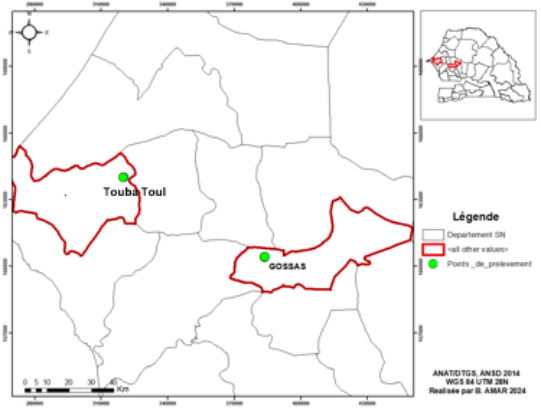
Figure 1. Geographical location of the soil sampling sites of Touba Toul and Gossas.
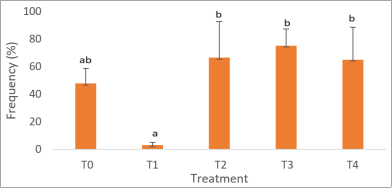
Figure 2. Frequency of mycorrhization of millet cultivated on Gossas soil under different inoculated and fertilized treatments.
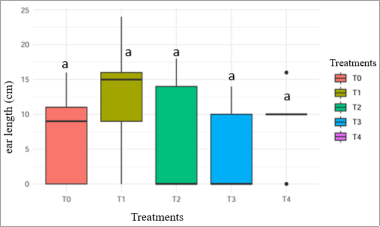
Figure 3. Effect of biofertilizers inoculation and microdose on ear length of millet cultivated on Gossas soil.
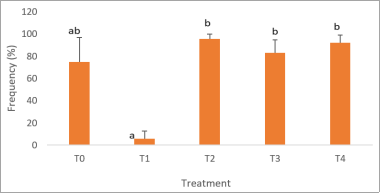
Figure 4. Frequency of mycorrhization of millet cultivated in Touba Toul soil, under different inoculated and fertilized treatments.
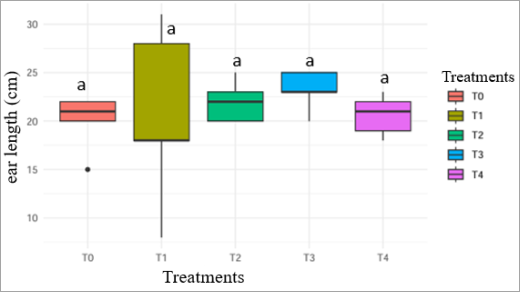
Figure 5. Effect of biofertilizers inoculation and microdose on ear length of millet cultivated on Touba Toul soil.

Information



 Share This Article
 Twitter
 Linked In
 Facebook
 Copy
Copy Download